Why Do Windows Users Rely on Bagas31 for Everyday Software Guides?
Walk up to almost any productive desk—whether belonging to a university student finishing a thesis, an independent podcaster editing weekly commentary, an accountant reconciling spreadsheets, or a software technician configuring fresh laptops—and you will notice one shared pattern. The machine feels responsive not because it holds the costliest graphics card on the market, but because the software running on it was chosen deliberately. Unnecessary background updaters stay disabled, documents open instantly in crisp viewers, audio records cleanly without stuttering, and utilities cooperate rather than fighting for memory.
Yet reaching that calm, dependable state often feels surprisingly challenging for everyday computer users. Search engines return thousands of fragmented blog posts, forum threads filled with conflicting advice, and product landing pages packed with vague marketing adjectives that rarely explain whether a tool works smoothly on modest hardware. Without a clear map of desktop software categories, many people install three overlapping programs to handle a single job and wonder later why startup takes twice as long as it did six months ago.
In this deep-dive exploration, we break down why structured software directories and concise desktop guides matter so deeply across modern computing. From window layout utilities and document workflows to podcast audio mastering, video encoding, portable app libraries, and seasonal maintenance routines, every section examines practical habits that keep Windows machines crisp, predictable, and easy to manage over the long haul.
The Shift Toward Intentional Desktop Software Choices
For years, casual technology coverage pushed the assumption that every personal workflow would eventually migrate inside a web browser tab. While cloud collaboration transformed shared calendars, live spreadsheets, and team messaging, real-world computing proved far more nuanced. Anyone who has tried editing a multi-track podcast over fluctuating Wi-Fi, batch-renaming four hundred raw camera files, converting complex PDF manuals offline, or troubleshooting disk space bottlenecks knows how indispensable native desktop applications remain.
Native Windows software runs directly against local memory, solid-state storage, and graphics hardware without waiting for remote server round-trips. Keystrokes register instantaneously, drag-and-drop file operations move gigabytes across drives in seconds, and audio interfaces deliver low-latency monitoring that browser sandboxes still struggle to match reliably. Moreover, in regions where mobile tethering or metered home broadband remains common, offline-capable tools allow students and remote professionals to remain fully productive on trains, in classrooms, or during temporary network outages.
As native software stayed vital, user expectations evolved too. People no longer want massive monolithic suites when a focused, twenty-megabyte utility accomplishes the job faster. Selecting lean tools that respect RAM and CPU resources has become one of the highest-leverage skills a laptop owner can develop.
Avoiding Software Bloat Before Installation
Most desktop slowdowns start innocently. Someone needs to trim a short audio clip, extract an archived project folder, or inspect a vector graphic, so they install the first giant suite suggested online. Weeks later, three separate helper services launch automatically at login, scheduled telemetry checks wake the disk while editing documents, and context menus stretch half the height of the monitor.
Intentional selection flips that habit around. Before downloading or installing anything, you ask three practical questions: what exact problem does this program solve, does an existing native utility already cover eighty percent of that job, and how cleanly can it be configured or removed later? Answering those questions turns software curation from impulsive downloading into calm workstation engineering.
Why Clear Documentation Beats Endless Trial and Error
Experienced technicians often forget how intimidating technical jargon looks to non-specialists. Terms like 64-bit architecture, lossless codec passthrough, shell integration, LUFS loudness normalization, or system restore checkpoints rarely come with plain explanations on developer repositories. When documentation skips practical context, everyday users resort to trial and error—installing and uninstalling multiple tools until something finally behaves as expected.
Structured guides eliminate that wasted afternoon. When an article groups programs logically by daily task—separating screen capture utilities from full timeline video editors, or distinguishing lightweight disk analyzers from aggressive registry cleaners—readers immediately understand where each application belongs. Clear compatibility notes detailing whether Windows 10, Windows 11, or specific runtime libraries are required prevent failed setups before they begin.
Equally valuable are honest discussions of hardware trade-offs. A laptop with eight gigabytes of memory and integrated graphics thrives on streamlined utilities and hardware-accelerated media tools, whereas heavy multi-layer animation suites demand dedicated video memory. Highlighting those boundaries respectfully saves beginners from blaming their computer when the real culprit was simply an oversized tool for the task at hand.
Reading Version Numbers, Dependencies, and Release Notes
Another often overlooked benefit of clear software documentation is learning how to read release changelogs calmly before updating working production machines. Not every minor point release needs immediate installation on the morning before a major client deadline. Knowing whether an update fixes a specific audio driver bug, introduces new Windows 11 interface hooks, or requires an updated runtime package allows users to time upgrades sensibly over a quiet weekend.
Checking dependency lists in advance also eliminates surprise error pop-ups during setup. When a guide explicitly mentions whether a lightweight visual runtime or audio library is expected, users prepare everything once in advance instead of troubleshooting missing DLL messages across multiple restarts.
Core Categories Every Windows Computer Needs
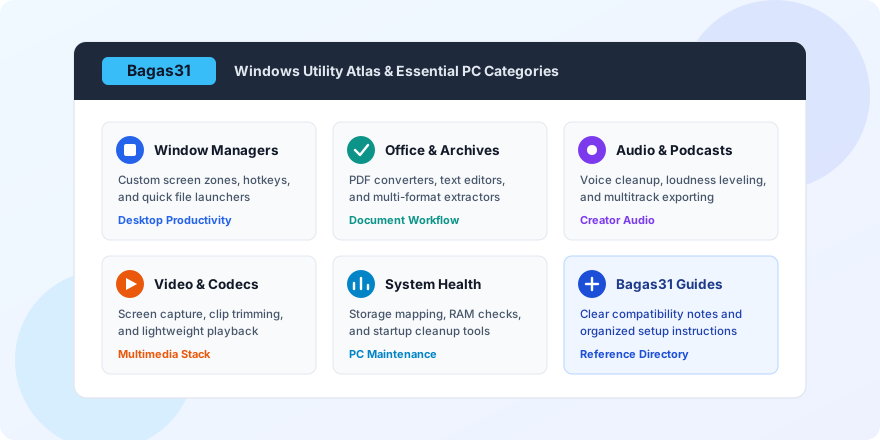
Rather than chasing trending app lists every week, building a solid Windows machine starts with six enduring functional categories. Once each slot holds one trustworthy, well-understood tool, your daily digital life handles ninety-five percent of academic, business, and creative demands effortlessly.
Window Management and Keyboard Productivity
Modern displays pack far more pixels than older screens, yet dragging individual windows manually into corners wastes surprising amounts of focus every day. Dedicated Windows utility suites allow you to snap research documents, reference spreadsheets, text editors, and media controls into customized grid layouts with a single modifier key. Coupled with quick application launchers that locate files or trigger system calculations directly from the keyboard, your hands stay productive without hunting through nested start menus.
Right-click file utilities provide another quiet boost. Batch image resizing shrinks heavy camera photos down to web-ready dimensions inside Windows Explorer itself, while bulk file renamers standardize messy folder names using sequential dates or clean prefixes in seconds. Even simple always-on-top window pinning proves invaluable when transcribing notes from a video lecture or comparing figures across two browser windows.
Browsers, Tab Discipline, and Profile Isolation
Because web apps still occupy a major share of work time, browser configuration directly governs laptop battery life and memory headroom. Keeping fifty active news tabs, streaming players, and social feeds loaded simultaneously can consume multiple gigabytes of RAM before you open a single creative tool. Modern productivity-minded browsers address this with automatic tab sleeping, split-screen viewing, and vertical tab trees that keep long research sessions readable.
Separating personal browsing from focused work or administration tasks using distinct browser profiles also improves clarity and security. One profile holds work extensions, project bookmarks, and analytics logins, while a clean secondary profile remains free of extra add-ons so web testing and media playback stay snappy.
Mastering Document Workflows, Text Editors, and Archives
Every profession crosses paths with documents, structured text, and compressed project folders. Whether preparing client proposals, cleaning CSV data exports, writing website markup, or sharing bundled slide decks, reliable document and archive tools keep information flowing smoothly across computers.
Handling Mixed Document Formats Without Friction
Collaborating across organizations inevitably brings diverse file types into your inbox. One partner sends modern DOCX reports, another exports legacy spreadsheets, and clients frequently expect finalized PDF summaries with locked typography and clickable tables of contents. Keeping a dependable office suite alongside a dedicated batch document converter prevents messy manual retyping whenever layouts need to travel between formats.
Speed matters just as much for PDF reading. Heavy document viewers loaded with cloud upsells and background indexing services make opening a two-page invoice feel sluggish. Lightweight PDF readers open instantaneously, preserve crisp zoom rendering on schematics and scanned forms, and let you highlight or annotate pages cleanly without distracting toolbars crowding the screen.
Why Plain-Text and Code Editors Belong on Every Desk
You do not need to be a full-time programmer to appreciate a tabbed plain-text editor on Windows. Standard word processors silently convert straight quotation marks into curly typographic quotes, add invisible paragraph styles, and choke on multi-megabyte log files. Fast native text editors handle raw configuration files, HTML templates, podcast show notes, JSON exports, and multi-line search-and-replace tasks smoothly.
Features like syntax coloring make spotting missing brackets or typos effortless, while column-mode selection allows you to edit twenty aligned lines simultaneously. Saving scratch notes in clean UTF-8 plain text also guarantees your writing remains readable on any operating system decades from now without proprietary lock-in.
Archive Managers and Checksum Verification
Project assets, font kits, audio sample packs, and software manuals almost always travel inside compressed archives. A clean archive utility supporting ZIP, 7Z, RAR, and TAR formats ensures smooth extraction regardless of which tool packaged the folder. Better yet, testing archive integrity before unpacking and verifying SHA-256 checksums on critical downloads confirms that nothing was truncated by an interrupted Wi-Fi drop.
Audio Clarity and Podcast Creation From a Regular Laptop
Spoken-word audio has exploded across technology education, community storytelling, and independent publishing. Listeners will forgive modest webcam framing in a tutorial video, yet harsh room echo, inconsistent microphone volume, or sharp background hiss causes people to close an episode within seconds. Fortunately, producing warm, broadcast-ready voice tracks does not require an acoustic booth when you pair sensible desk placement with smart desktop audio editors.
Capturing Clean Speech and Cleaning Room Noise
Good microphone habits start with distance and surroundings. Positioning a USB condenser or dynamic mic six to eight inches away at a slight angle reduces harsh plosives while keeping your voice prominent over distant street traffic or laptop fans. Once recorded inside a dedicated desktop audio editor, inspecting the waveform visually reveals silent breath gaps, background hum profiles, and accidental volume spikes.
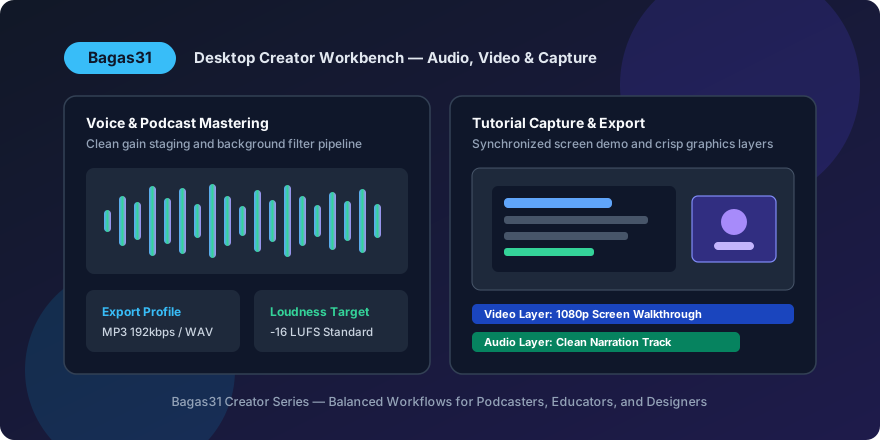
Applying subtle noise reduction trained strictly on two seconds of ambient room silence removes steady hum without making your voice sound robotic. Following up with gentle high-pass filtering trims low-frequency desk rumbles below eighty hertz, while subtle compression evens out quiet and energetic passages so listeners never scramble for their volume knob while commuting.
Loudness Standards and Multi-Format Exporting
Online podcast hosts and streaming directories sound much more cohesive when every episode meets consistent loudness targets, typically around minus sixteen LUFS for stereo spoken audio or minus nineteen LUFS for mono voice tracks. Desktop mastering plugins and loudness meters take the guesswork out of exporting. Keeping lossless WAV masters archived locally while exporting clean 128 to 192 kbps MP3 files for web publishing preserves high sound quality alongside fast listener streaming.
Screen Recording, Video Compression, and Playback Codecs
Alongside podcasts, short walkthrough videos and annotated screen tutorials remain one of the clearest ways to teach software techniques. Whether explaining a spreadsheet formula to coworkers or demonstrating a Windows productivity feature publicly, picking the right capture and media conversion workflow makes creation enjoyable rather than exhausting.
Capturing Sharp Desktop Tutorials Without Massive Files
Many first-time recorders make the mistake of capturing raw lossless video at ultra-high bitrates for routine desktop explanations, generating ten-gigabyte files for a five-minute clip that chokes modest video editors. Selecting smart recording presets—capturing your display at native 1080p resolution, thirty frames per second for interface walkthroughs, and hardware-accelerated H.264 encoding—yields crisp, readable menus at manageable file sizes.
Recording your microphone narration onto a separate audio track from desktop notification chimes gives you tremendous flexibility during editing. If a sudden system alert pings mid-sentence, you can mute that single second on the desktop track without re-recording your explanation.
Media Converters Versus Full Video Timelines
Before opening a heavy multi-track video suite, ask whether your task is simple conversion or genuine creative editing. Fast dedicated media converters excel at trimming leading silence, rotating sideways smartphone footage, extracting clean audio streams from recorded webinars, or shrinking bulky exports so they upload quickly over slower connections. Saving full nonlinear video editors strictly for multi-scene storytelling keeps turnaround times brisk.
Keeping Media Playback and Codecs Trouble-Free
Testing finished exports locally requires a trustworthy media player capable of decoding diverse containers smoothly. Classic lightweight desktop players remain unmatched for frame-by-frame inspection, subtitle synchronization checks, and reliable color reproduction across MKV, MP4, WebM, and FLAC files. Avoiding redundant, conflicting codec installations preserves clean Windows media handling while keeping playback effortless.
Managing Export Bitrates for Fast Web Uploads
Many new video educators render short software guides at needlessly high bitrates, waiting thirty minutes to upload a file that streaming platforms immediately recompress anyway. Using variable bitrate two-pass encoding tuned for desktop screen content keeps fine menu text razor-sharp while shrinking export sizes by more than half. Pair clean MP4 containers with AAC stereo audio so your tutorials play identically across desktop browsers, tablets, and mobile phones without re-encoding hiccups.
Vector Branding, Thumbnail Design, and Digital Asset Hygiene
Visual consistency ties your blog articles, podcast episodes, and technical guides together immediately. Listeners scrolling through crowded feeds notice clean episode cover art, crisp typography, and readable diagrams long before they click play. Understanding how vector and raster graphics tools complement one another helps non-designers create sharp branding without bloated project folders.
When to Choose Vector Shapes Over Raster Pixels
Logos, UI badges, workflow flowcharts, and minimalist cover illustrations belong in vector graphics software or clean SVG templates. Because vector graphics define lines and curves mathematically, a brand badge looks razor-sharp whether displayed inside a small podcast thumbnail or stretched across a wide desktop banner. File sizes also stay remarkably tiny—often just a few kilobytes—allowing web articles to load almost instantaneously.
Raster photo editors remain ideal whenever working with real camera photographs, lighting exposure adjustments, portrait retouching, or soft background blurs. Exporting final web thumbnails at exact target dimensions—such as 1400 by 1400 pixels for podcast episode covers or 16:9 widescreen banners for article headers—prevents awkward automatic cropping across social previews.
Naming Assets Cleanly Across Projects
Nothing slows down a creative series faster than folders filled with files named `final_v2_new_fix.png`. Adopting lowercase hyphenated naming conventions paired with clear project subfolders—separating raw recordings, source vector files, and final compressed web images—lets you locate or update any visual asset months later in seconds.
Portable Apps, Standalone Installers, and Clean File Storage
Power users quickly discover the elegance of portable software ecosystems. Unlike traditional installers that scatter settings across hidden AppData folders, Program Files directories, and Windows Registry branches, portable applications store their executable and configuration preferences inside one self-contained folder.
Benefits of Portable Toolkits on Shared and Secondary Drives
Maintaining a curated portable tools folder on a secondary partition or fast USB drive offers immediate flexibility:
- Zero system clutter during evaluation: Testing a new disk analyzer, color picker, or plain-text utility inside a portable folder leaves your main Windows Registry untouched if you decide not to keep it.
- Instant migration between computers: Copying one folder transfers your exact keyboard shortcuts, presets, and window themes onto a fresh laptop without repeating manual setup screens.
- Reliable offline availability: Standalone installers and portable builds let technicians configure workstations cleanly even when internet access is restricted or temporarily unavailable.
- Predictable project isolation: Keeping creative plugins and utility scripts neatly grouped prevents accidental dependency breaks when updating unrelated applications.
Disciplined Folder Layouts for Long-Term Clarity
Outside your installed programs, keeping user files organized across predictable top-level directories—such as Documents, Active Projects, Archived Masters, and Installers—prevents the Downloads folder from becoming an unsearchable digital attic. Reviewing Downloads once every Friday afternoon and either filing useful installers or deleting spent temporary files takes three minutes and keeps storage lean permanently.
Startup Discipline, RAM Checks, and Thermal Awareness
Even carefully chosen software eventually feels sluggish if hardware health and background processes are ignored. Monitoring basic system metrics does not require obsessively staring at charts; it simply means checking a few vital signs periodically so minor bottlenecks never snowball into crashes during critical deadlines.
Trimming Startup Load and Background Services
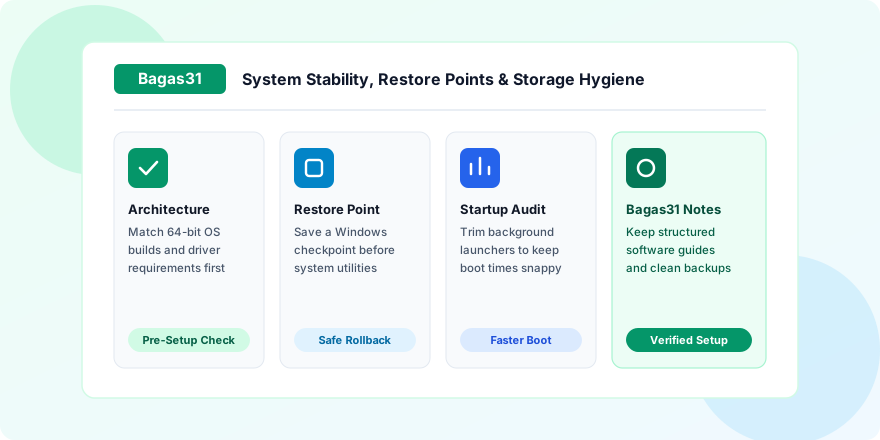
Whenever a newly installed utility asks permission to launch automatically when Windows starts, pause and consider whether you truly need it running on every single boot. Audio editors, PDF converters, archive managers, and screen recorders only need to run when you intentionally open them. Auditing Task Manager’s Startup tab monthly and toggling non-essential helpers to disabled cuts boot times noticeably and frees hundreds of megabytes of idle RAM before your day even begins.
Checking background network and disk activity similarly exposes runaway sync loops. If cloud storage clients monitor active video render folders or audio scratch drives, every temporary file write triggers instant upload traffic. Pointing active scratch directories outside synced folders and copying only finished outputs into cloud folders keeps drives cool and responsive.
Understanding Storage Headroom, Memory Health, and Cooling
Solid-state drives deliver peak speed and wear leveling only when sufficient free blocks remain available. Keeping at least fifteen to twenty percent of your primary drive unallocated protects write speeds during large video exports and Windows updates. Meanwhile, running occasional memory diagnostics after hardware upgrades or noticing sudden cooling fan noise reminds you when dust cleanup or thermal maintenance is overdue.
Backup Routines, Restore Points, and Multi-Device Consistency
Confidence at the keyboard comes from knowing that a single hardware hiccup or misconfigured driver update cannot erase months of creative work. Reliable backup discipline rests on separation: separating your operating system setup from your irreplaceable personal files, and maintaining automated copies across more than one physical location.
Using System Restore Before Major Software Changes
Whenever you plan to install deep system-level utilities—such as virtual audio cable drivers, shell extensions, or updated graphics packages—taking thirty seconds to create a named Windows System Restore checkpoint gives you an effortless undo button. Should an updated audio driver introduce crackling during podcast recording, rolling back restores your working configuration cleanly without touching personal documents or media recordings.
Following a Simple Multi-Copy Backup Rule
Important documents, episode masters, tax spreadsheets, and website code should never live in only one place. Keeping your active working copy on your primary SSD, an automated incremental backup on an external drive or secondary disk, and a mirrored archive of finalized work in encrypted cloud storage protects against accidental deletion, drive wear, and laptop theft simultaneously. Testing a random file restore once every quarter confirms your backups actually work rather than quietly failing silently.
Standardizing Workflows Across Multiple Computers
Many professionals split time between a home desktop workstation and a lightweight laptop on the road. Writing down a brief personal setup checklist—recording your favorite window manager layouts, audio loudness targets, browser extensions, and essential utilities—allows you to keep keyboard shortcuts and file paths identical on both machines. Muscle memory stays intact regardless of which desk you sit at.
Closing Perspective on Long-Term PC Simplicity
Technology should accelerate your ideas rather than demand constant babysitting. The reason everyday Windows users seek out organized software directories and practical desktop walkthroughs is rarely curiosity alone; it is the desire for clarity in an overwhelming landscape of choices. When applications are grouped logically, compatibility notes are stated plainly, and bloated overlaps are avoided from day one, even a modest laptop turns into a fast, dependable workstation.
Whether you are setting up a clean computer for university study, assembling a compact podcast and screen-recording workflow, managing office documents smoothly, or refining long-term backup and startup habits, consistency beats complexity every single time. Choose tools that fit your real tasks, keep clean notes on how they work together, maintain sensible system checkpoints, and let your desktop stay quietly out of the way while you create your best work.
Keeping Your Software Toolkit Future-Ready
Operating systems evolve continuously, introducing updated security boundaries, sharper display scaling rules, and hardware acceleration improvements for modern media codecs. Setting aside a brief seasonal checkup every three months keeps your toolkit aligned with those shifts without disrupting active deadlines. During each quarterly review, retire utilities you have not opened in months, confirm that your backup drives still verify cleanly, and review release notes for any core creative applications you depend on weekly.
Over time, this simple rhythm transforms how you view desktop computing. Instead of dreading system maintenance or guessing blindly through endless download menus, you maintain an agile, predictable Windows workstation built around clarity, efficiency, and lasting creative control. Every utility earns its place on your drive, routine tasks feel lighter, and your computer stays ready whenever inspiration strikes.